 5 hours ago
5
5 hours ago
5
Having an accurate valuation of your dental practice is the starting point for every significant financial decision you’ll make as a practice owner. I've spent over a decade as an M&A advisor, and as the founder of DealRoom and M&A Science, I've had a front-row seat to hundreds of business transactions across industries. Through 400+ interviews with the practitioners who actually run deals, one pattern keeps coming up: sellers consistently leave money on the table because they never took the time to understand what their business was really worth before they needed to know. Dental practices are no exception. In fact, given how fast consolidation is reshaping this industry, the stakes for dental practice owners may be higher right now than for almost any other sector I've covered.
There’s a lot on the line, and the clock is ticking. Dental industry consolidation is projected to increase from the current 35% to 60-70% by 2029, according to experts from Professional Transition Strategies.
Today’s independent sellers have the opportunity to capitalize on a buyer’s market that may no longer exist in just a few years. In this blog, we’ll cover how professionals value a dental practice, what influences value to go up or down, and what you can do today to maximize the worth of your life’s work.
Practice Information
Annual Collections $800,000
Annual EBITDA/Net Income $200,000
Years in Operation 15 years
Valuation Results
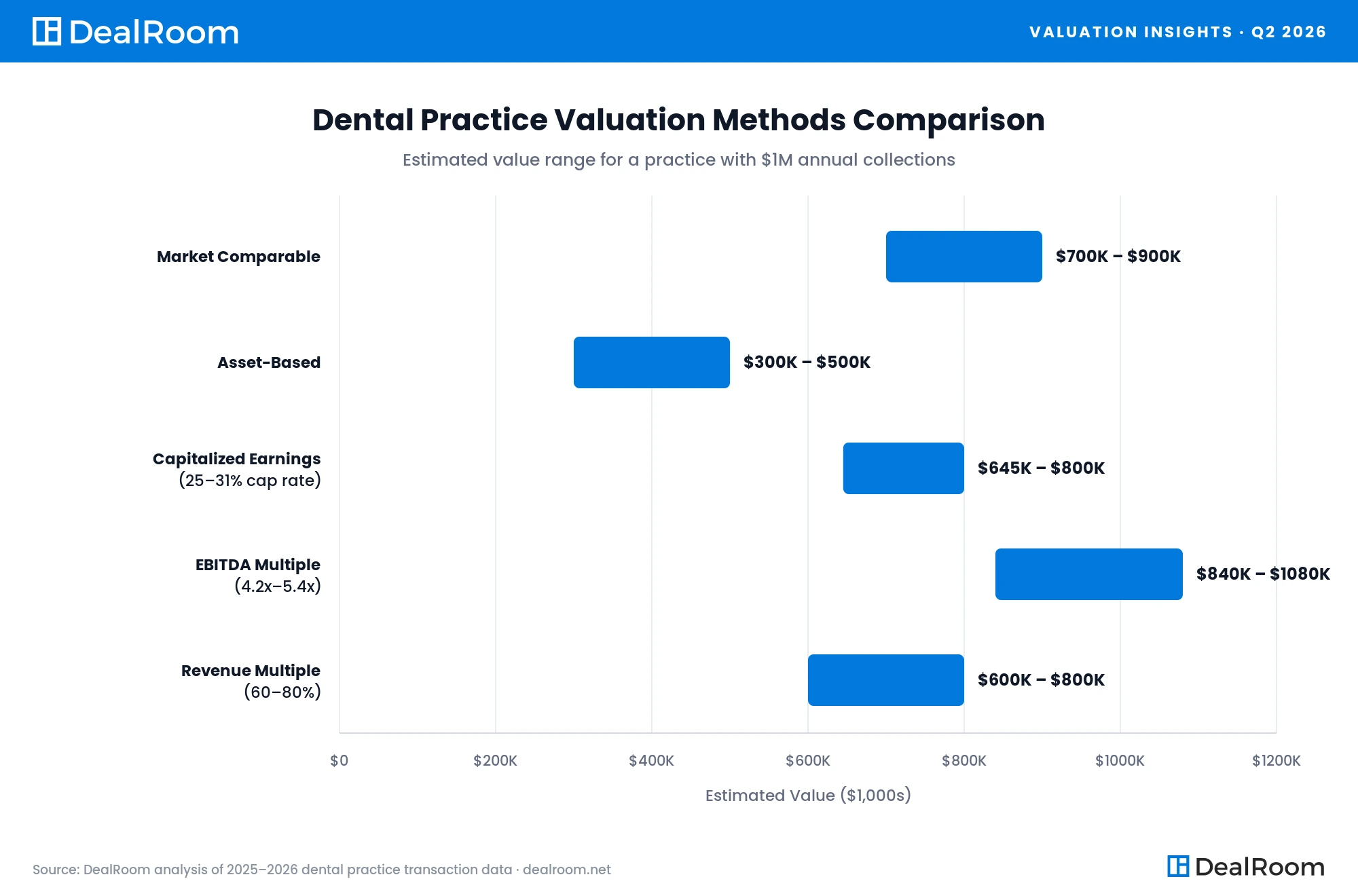
Revenue Multiple Method
Collections × 0.60–0.80
EBITDA Multiple Method
EBITDA × 4.2–5.4
Capitalized Earnings Method
EBITDA ÷ (0.25–0.31)
Market Comparable (Location-Adjusted)
Weighted average with location factors
Most Likely Valuation Range
$645,625 – $840,000
Key Value Drivers
- Higher collections and consistent EBITDA increase valuation
- Specialty practices (Ortho, Oral Surgery) command 15–25% premium
- Urban locations valued 10% higher than suburban markets
- Established practices (10+ years) are more attractive
- Strong patient base indicates revenue stability
Disclaimer: This calculator provides estimated valuation ranges based on industry-standard multiples and methodologies. Actual practice valuations depend on many factors including patient retention, growth trends, lease terms, equipment condition, and market-specific conditions. These estimates are for informational purposes only and should not be considered professional business or financial advice. Consult with a dental practice valuation expert or broker for accurate valuations.
Understanding Dental Practice Valuation
Dental practice valuation is a method used for establishing the fair market value of a dental practice based on financial data, patient demographics, dental equipment used, and market conditions. This method is used by dental practice buyers and professional dental practice appraisers.
Why Practice Owners Need to Understand Their Value Now
Traditionally, dentistry has been a solo practitioner industry in the U.S. While that model still makes up the largest share of dental providers on paper (nearly 178,000 practices in 2025 with no one player owning more than 5% of the market), the trend toward consolidation is stronger than ever behind the scenes. Dentists are partnering up with large group practices and dental support organizations (DSOs) at accelerating rates, led by the youngest generations entering the profession.
Nearly three out of every ten dentists (27%) with less than ten years since dental school were DSO-affiliated in 2024, up from 24% the previous year, according to a June 2025 report from the American Dental Association (ADA). Only 15% of young dentists practiced solo. The trend is reversed when looking at dentists with 25 or more years in the business. Close to half of those dentists were sole owners, compared to just 9% that were DSO-affiliated.
Practice ownership itself is now a longer journey. Only 73% of dentists own their practice today, down from 85% in 2005. As DSOs and corporate practice groups become more prominent in dentistry, ownership looks much different than it did for previous generations. If you’re nearing retirement, planning a partnership buy-in, or just curious about your practice’s value in a shifting marketplace, knowing the current valuation of your practice has never been more critical.
What Is Dental Practice Valuation?
Dental practice valuation is a step-by-step method used for determining the worth of your dental practice based on both physical and non-physical factors. The non-physical factors may include your revenue streams, patient demographics, dental practice equipment, dental practice lease terms, dental staff, and your dental practice compared to your competitors.
Most often, they’ll use more than one. You’ll see income-based methods, which rely on how much your practice makes, as well as asset-based methods, which add up all your possessions, and market-based methods, which compare your practice to others recently sold in your area.
Many dentists assume that there’s a single, straightforward formula for valuing a dental practice that both buyers and sellers can agree on. “In reality, valuing a business, including a dental practice, is a much more subjective process than most dentists realize,” Dental Buyer Advocates explains.
A certified valuator will use methodologies from The National Association of Certified Valuation Analysts. The value of your practice is not an exact number, but rather a range. The range can fluctuate based on who is buying your practice and for what reason.
Importance of Accurate Valuation
Accurate valuation is essential to your interests, whether you are buying, selling, buying out a partner, getting a loan, or planning your estate. As Schiff & Associates explains, “Accurate valuation not only illuminates a practice’s current standing but also guides strategic decisions that can lead to increased profitability.” If your practice is overpriced, it can linger on the market for too long and ultimately sell for less than it’s worth, which is bad for your reputation.
If your practice is underpriced, then you’re losing money. Banks require a professional valuation before giving you a loan to make acquisitions, and the IRS checks to make sure your values match fair market standards.
Accurate numbers are essential for your taxes, especially when dividing your sales between goodwill and equipment. Your insurance coverage is also based on your true value, so you aren’t left high and dry if disaster strikes.
Common Valuation Objectives
You might need to get your practice valued for immediate sale planning if you’re ready to retire from your practice. Knowing what’s going on in the current marketplace and what your buyers are expecting can help you price your practice for sale.
Another situation where partnership restructuring arises is when you’re adding or removing partners. This calls for proper calculation so that everyone is treated fairly.
Financial planning and benchmarking can assist in tracking your progress or comparing yourself with others in the industry. Regular valuations will show you if your strategies are actually building equity.
Having your business valuation done two years prior to your desired sale time can give you time to correct problems and increase your sale price.
Key Factors Affecting Dental Practice Value
There are several factors that contribute to the value of your dental practice at the present time. Your revenue, patient demographics, location, and business structure each have their own importance.
Revenue Streams and Profitability
The way your dental practice earns its revenue is an important factor in determining your practice’s value. Fee-for-service practices will have more value compared to insurance-based practices, especially if you’re tied into the lower-paying insurance contracts.
Not only is the revenue earned by your dental practice important in determining value, but the profit margin is more important than the revenue earned. A dental practice earning $800,000 with a profit margin of 40% is more valuable than one earning $1 million with a profit margin of 25%.
Consistent revenue is key in building value in your dental practice. A dental practice with consistent or increasing revenue over the past few years will be more attractive to potential buyers. A dental practice with declining revenue will be less attractive and will likely have lower value.
Patient Base and Demographics
The number of active patients you have and the ability to bring them back regularly will impact your potential earnings in the future. A dental practice with 1,500 active patients in regular hygiene schedules is more attractive compared to one with inactive patient files.
Patient age and history are important factors as well. A younger patient mix means a longer relationship ahead, while an older patient mix means they have come to trust you. Your payer mix is important as well because patients who are open to higher-value procedures mean higher value for your practice.
Another factor is new patient flow. A high number of new patients is a sign of health. If you have 20-30 new patients per month coming in through referrals, that’s a sign of a healthy reputation, so you don’t have to spend as much money on marketing.
Location and Market Demand
Location is something you cannot change, but it is important. Urban/suburban locations in growing communities will have higher valuations than rural locations in shrinking communities.
Another factor is the demand for services in your location. One dentist per 1,500 to 2,000 people is healthy competition. Over-saturation of the market will negatively impact valuations.
Facility
Facility details can add value as well. A highly visible location, plenty of parking, easy access, and being located near other healthcare providers can increase the value of your practice.
Staff and Management Structure
Another factor is the experience of your staff and their longevity at the practice. This is important because buyers want people who know the patients and the practice.
Having well-documented systems is important as well. This shows buyers that you have a well-run practice. They’re typically willing to pay more for a practice with good management in place.
Having the key staff stay on after the sale can be a significant benefit. If your associate dentists, office manager, and hygienists plan to stick around, this can be attractive to the buyer and increase the sale price.
Market Timing and Consolidation Window
When your practice is put on the market matters just as much as what it brings to the market. Independent practice owners may have less time to weigh their options than they think. Professional Transition Strategies’ experts expect the dental industry to grow from the estimated consolidation rate of 35% as of 2024 to between 60% and 70% by 2029.
With more than 375 DSOs currently competing to acquire quality practices in the U.S., sellers today benefit from a competitive buyer landscape that drives up offers and deal flexibility. But that dynamic won’t last forever.
As Kim McCleskey, a practice transition consultant with over 30 years in dentistry, put it: "Once we reach this point, the majority of practices will be owned by DSOs, marking a fundamental shift in the ownership landscape. The market is expected to stabilize after this period, reducing practice sale values, which is why it's important for dentists to understand their options now."
Understanding what your practice is worth, and what factors are driving that value, is the essential first step in making the most of the current market before conditions shift.
Valuation Methods for Dental Practices
There are three main methods by which professionals evaluate dental practices. Each of these methods considers various elements of your practice. All three put the complete picture together to determine the worth of your dental practice.
Income Approach
This approach evaluates your practice in terms of its capacity to earn income in the future. The income approach uses either the discounted cash flow method or the capitalized excess earnings method.
Discounted Cash Flow involves taking your projected future cash flow and converting it to present day money using a discount rate between 15% and 25%.
Capitalized Excess Earnings uses your profit above and beyond what your physical assets would earn if they were operating on their own. The income approach uses the capitalization rate.
Currently, suburban general practices tend to sell in the range of 4.2 to 5.4 times EBITDA. This is changing from the older approach of valuing by revenue.
This approach is best suited for practices with more consistent and reliable income flow. Your patient retention rate and fee structure are considered in this approach because they affect your earnings.
Market Approach
This approach compares your practice to similar practices in your region that were recently sold. The market approach uses actual sales data from your region.
Factors considered in the comparison include the size of the practice, patient mix, production, and the practice’s location.
The most common multiples used in the market approach are revenue multiples (gross collections), EBITDA multiples, and the number of active patients. This method will provide you with a real-world validation of your practice’s value. However, if your practice is in a rural area or has a specialized practice, it can be difficult to find comparable practices.
Asset-Based Approach
The asset-based approach consists of adding up your tangible and intangible assets. So, your equipment, your supplies, your furniture, and your goodwill will all be factored in to give you a value.
The equipment will be based on the fair market value of the equipment today. So, it doesn’t matter when you bought the equipment or what you paid for it. Your intangibles will be your patient base, your goodwill, your location, and your employee relations.
This method will give you the minimum value for your practice. This method will be more useful to you if your practice has newer equipment or if the sale is more based on the equipment than the cash flow.
Calculating Practice Financials
Calculating the financials for your practice is the foundation upon which your practice value will be based. The main financial figures will be your adjusted net income, your EBITDA, and your normalized financial statements.
Adjusted Net Income
Adjusted net income will give you a clear picture of your practice’s income: it’s the income your practice actually makes. You can exclude owner-specific and discretionary expenditures. This will be different from your income tax returns because it will exclude expenditures that a new owner wouldn’t incur.
The adjustments will include adding back in extra owner income, personal expenditures, and non-recurring expenditures such as big repairs or legal fees.
Start with your net income from tax returns and add back in expenses like personal car expenses, inflated salaries for family members, inflated rents for family members, and anything else you spent money on for the business.
Earnings Before Interest, Taxes, Depreciation, and Amortization (EBITDA)
EBITDA is a measure of profit, eliminating expenses like interest, taxes, depreciation, and amortization, which vary according to the business’s ownership.
Start with your net income and add back in interest, taxes, depreciation, and amortization.
Most dental practices are sold at 3x to 8x EBITDA.
Buyers like EBITDA because it’s a real measure of the way the business operates.
For instance, if you have a dental practice with an EBITDA of 500,000 and you sell it for 5x, you’ll have a valuation of $2.5 million.
Normalization of Financial Statements
Normalization of financial statements makes adjustments to your statements so they look like they would for a typical buyer.
This includes removing one-time expenses and owner-specific expenses.
For instance, you might remove unusual insurance claims and add in market rate salaries for your staff.
Other things you might add in include:
- Owner’s salaries at market rate for associates
- Rent at fair market rate if you own the building
- Market rate salaries for your staff
- Personal expenses
- Deferred maintenance costs
- Capital expenditures
Other Non-Financial Factors That Impact Value
The value of a dental practice is not just about money. Your reputation, the condition of your office, and patient loyalty all contribute to the saleability and value of your practice.
A good reputation and loyal patient base can make all the difference in the saleability and value of your practice. You want to be the practice everyone wants to own, not the practice nobody wants to own.
Your reputation is a major factor in the saleability and value of your practice. Buyers will pay more for a practice with a good reputation and high patient loyalty. If you have a rating of 4.5 stars and above, you’ll get a premium value compared to other similar practices with low or no reputation.
Being active in local charity events is a great way to build goodwill. Showing up to health fairs and other local events demonstrates to patients that you care about the local community and are not just focused on making money.
Key factors that contribute to goodwill value include: Years of operation, staff longevity and their relationship with patients, membership and participation in local organizations and associations, and absence of malpractice suits and government actions.
Dental Practice Goodwill Valuation

Goodwill is the intangible value of a dental practice beyond the practice’s tangible assets. It’s an important part of the practice’s value, so you should understand how to calculate goodwill to ensure you get the highest possible sale value.
Goodwill Valuation Methodology
There are two primary methods to calculate goodwill.
Excess Earnings Method: This method involves subtracting the fair market value of tangible assets from the total valuation of the practice, and the difference is the amount of goodwill. For instance, if the valuation of a dental practice is $1.2 million and the tangible assets are worth $300,000, the amount of goodwill will be $900,000.
Capitalization Method: This method involves capitalizing the excess earnings, which are the earnings in excess of those the buyer would have earned from the tangible assets. For instance, if the normalized EBITDA of a dental practice is $400,000 and the tangible assets would have earned 80,000 at a standard rate of return, the excess earnings would be 320,000, which will be capitalized at a market rate of return (typically 20-25%) to arrive at the amount of goodwill.
Typical Goodwill Percentages
Goodwill normally ranges from 60-80% of the total valuation for an established dental practice. This is because there’s a high value placed on the relationships, reputation, and referral base, as well as the trained management systems that come with the sale of your practice. For newer dental practices, the amount of goodwill will normally be 40-60%.
The high amount of goodwill is a major reason why it’s so important for you to develop a reputation and a strong base of loyal patients for your dental practice.
Equipment and Facility Condition
Having modern equipment will greatly benefit you in the sale of your dental practice because it will save the buyer money. Dental practices with digital radiology, intraoral cameras, and modern equipment in the operatories will attract more buyers than those with outdated equipment.
The equipment in your dental practice will greatly influence the amount of goodwill you will eventually receive for your sale. Dental equipment that’s less than five years old will add full value, while outdated equipment will detract from the valuation.
Your facility condition will also affect the buyer. If the facility is clean and well-updated, it will create an impression that the practice is well-managed. On the other hand, if the facility is old and not well-maintained, it will create an impression that the practice is not well-managed and will require additional investment to upgrade the facility.
Critical Facility Condition
ADA-compliant and accessibility features, number and layout efficiency of operatories, HVAC, plumbing and electrical, parking and building curb appeal.
Patient Retention Rate
Your patient retention rate will provide an indication of the stability of your practice and will be an important factor in predicting future earnings. Buyers want to know that patients are happy and will stay with the practice even after the sale.
If you have an annual patient retention rate of over 85%, this is a good sign. This can be calculated by dividing by the total number of active patients. Buyers are much more interested in the number of active patients than the number of patient records. Buyers want to know how many patients have been seen over the last 18 to 24 months. A practice with 1,200 active patients is much more valuable than a practice with 3,000 patients if only 800 are active.
Preparing for a Dental Practice Valuation

The foundation for an effective dental practice valuation is good preparation and understanding of the basics. These basics include professionals and disclosure of liabilities, and they provide a foundation for the accurate assessment of the value of your practice.
Gathering Essential Documents
You will also need to gather financial information for a minimum of three years, which will require gathering tax returns, profit and loss statements, balance sheets, and accounts receivable aging reports.
Include information on patient demographics, acquisition of new patients, and patient retention statistics. Your equipment inventories, including dates of purchase, should also be included. Your lease agreements, employment contracts, and vendor contracts should be readily available. Patient charts should be up to date and well-maintained, as this is an intangible asset.
Your revenue should be broken down to show types of procedures to make it easier for the valuator to understand your practice. Documentation for any ongoing litigation, insurance, and compliance issues should be readily available.
Engaging Professional Valuators
A valuator with a Certified Valuation Analyst (CVA) designation is preferred. However, if you can find one with a dental-specific designation, it’s even better. Business appraisers without dental experience can overlook critical factors such as patient retention and revenue generated from procedure types.
Interview several valuator firms to compare methods and fees. Check if they have experience with your type of practice, such as your practice size, specialty, and geographic location.
An experienced valuator should be able to explain if they use an asset-based, income-based, or market-based approach. Check for references from other dental practice owners who have utilized their services.
Ask for a timeline and how involved you need to be in the process.
Addressing Practice Liabilities
All outstanding debts, such as equipment loans, real estate mortgages, and credit lines, should be disclosed. Outstanding liabilities can kill your sale or significantly decrease your valuation.
Malpractice, patient, and staff-related issues should be addressed. Overdue vendor payments and taxes should also be included.
Employee-related liabilities, such as vacation pay and retirement plans, should be taken into consideration. Lease agreements should be reviewed, as this can significantly impact your valuation, especially if you are renting.
Common Mistakes to Avoid in Valuing a Dental Practice
The process of valuing a practice correctly involves delving into the financials, being aware of the ever-changing market trends, and being honest about the cost of running your business. If you leave out the details, your valuation will be nowhere close to the real figure.
Not Accounting for Hidden Liabilities
Hidden liabilities will erode your practice value by thousands. Outstanding lawsuits, unpaid taxes, or equipment leases will be a burden on the new owner.
Not factoring in the cost of maintaining your equipment will also hurt your practice value. If your sterilization equipment, dental chairs, or imaging machines are on their last legs, the new owner will factor in the cost to replace them.
Employee liabilities such as accrued vacation time, unpaid bonuses, and workers’ compensation will also affect your practice value. Environmental factors such as improper disposal of amalgam or lapsed OSHA requirements will also cost you a pretty penny.
A diligent buyer will uncover all the above factors. A pre-audit of all possible liabilities will give you a more accurate figure to begin with.
Not Accounting for the Current Market Trends
The current market conditions will dictate the price buyers are willing to pay. If interest rates go up, buyers’ offers will go down. Your practice will be a great deal regardless, but the offer will reflect the high interest rate.
The saturation of the market in your area will also impact the price. If there are many other practices for sale in your area, the buyers will have the upper hand. However, in a high-demand area with few other practices for sale, you will be able to command a premium price.
Corporate dental groups are buying many practices, and their criteria for a practice will vary. Insurance reimbursement in your area will also impact your practice value.
Patient demographics and local population growth can also give you hints about your practice’s future.
Underestimating Operational Expenses
Overestimation of practice value is another common mistake. This occurs when you underestimate your practice's operational expenses. This may happen when you run your personal expenses through your practice or when you're overpaying yourself.
These figures will be adjusted or “normalized” when a buyer tries to buy your practice. The cost of supplies may appear artificially low if you have special relationships or discounts that will not be available to a new owner.
Operating expenses such as labor may be based on market rates for hygienists, assistants, and administrative staff. Technology and software subscriptions are continually increasing as more dental practices become digital.
Rules of Thumb vs. Professional Valuation
Dental practice owners are often exposed to “rules of thumb” for practice valuation. These are most commonly based on a percentage of gross collections. This percentage varies between 60% and 80%.
While these are commonly used as a quick method for practice valuation, there are many factors that are commonly ignored, which can have a significant impact on practice value.
The Problem with Rules of Thumb
Rules of thumb assume all dental practices are created equally. However, there are many significant variables that impact practice value.
For example, two dental practices may have the same collections but will have very different values.
Let's say Practice A has a gross revenue of $750,000 and net margins of 40% or $300,000 in EBITDA. Practice B has a gross revenue of $750,000 and net margins of 20% or $150,000 in EBITDA.
Both dental practices will have a value of $525,000 according to the 70% rule of thumb. However, Practice A will have a value of $1.5 million based on a 5x multiple of EBITDA, while Practice B will have a value of $750,000 based on a 5x multiple of EBITDA—a difference of $750,000.
Another example: A practice with 1,200 active patients and consistent recall patterns versus one with 900 active patients and irregular attendance would have different retention risk profiles. However, the percentage of collections approach treats both practices the same.
Why Professional Valuations Are More Accurate Than Rules of Thumb
Professional valuators use several methods simultaneously: the income approach, the asset approach, and the market approach. They use this combination of methods to arrive at the most accurate valuation. They consider the local market conditions, the age of the practice, the age of the staff, and the growth potential of the practice. They normalize the compensation to the owner. They uncover the “hidden” liabilities. They consider the lease terms.
Professional valuations take into consideration several key elements that the rules of thumb completely ignore. These elements include patient demographic trends, the quality of the payer mix, the distribution of the procedure mix, the age of the equipment, the condition of the facility, the level of regulatory compliance, and the sustainability of key revenue streams.
When Rules of Thumb Can Lead the Practice Owner Astray
If the practice owner uses the 70% collections approach, they may be convinced that their $1 million collection practice is worth $700,000. However, the professional appraisal may turn out to be $850,000 because of the practice’s high margins and retention. The practice owner may be overpaying for the practice. The professional appraisal may turn out to be $520,000 because of the practice’s low overhead. The practice owner may be underpaying for the practice.
Valuation by Specialty Type
Dental practice valuation multiples vary depending on the specialty. The profitability of the practice and the recurring nature of the practice income streams affect the multiples. The demand for the specialty affects the multiples. The multiples may be higher for specialties such as orthodontics. The multiples may be lower for specialties such as general practice.
| General Dentistry | $500K-$1.5M | 4.0x-5.5x | 60-80% | Patient retention, recurring hygiene, overhead control |
| Orthodontics | $750K-$2M+ | 5.0x-6.5x | 75-90% | Long-term patient contracts, high net margins, recurring payments |
| Oral Surgery | $1M-$3M+ | 4.5x-6.0x | 70-85% | Complex procedures, referral relationships, procedure-based pricing |
| Periodontics | $600K-$1.8M | 4.5x-6.0x | 65-80% | Recurring maintenance, high-value procedures, specialist positioning |
| Endodontics | $500K-$1.5M | 4.5x-6.0x | 65-80% | Referral-based business model, specialized skills, procedure-based pricing |
Specialty Notes:
Orthodontics tends to have the highest multiples because of the multiple year patient contracts with high net margin potential.
Surgical specialties like Oral Surgery, Periodontics, Endodontics have strong multiples because of the referral-based business model and procedure-based revenue streams.
General dental practices have lower multiples because of the overhead expenses, price pressure from the patient base, and the need to rely on patient retention in a competitive environment.
Rural practices in any specialty will command 10-20% lower multiples compared to their urban counterparts.
Group practices with multiple locations or practitioners will command 10-30% higher multiples because of the lack of owner dependence.
Utilizing the Results of the Dental Practice Valuation in Strategic Business Decisions
While the dental practice valuation is used to determine the sale price of your dental practice, it is not the end of the process. The information provided can be used in strategic business decisions.
Partner or Associate Buy-In
You can utilize the dental practice valuation in determining the equity split or buy-in amount in case of a partnership or associate buy-in.
Practice Growth Strategy
The dental practice valuation will give you an idea of the key factors that affect the value of your dental practice. It can be used in determining the need to reduce overhead expenses or the potential to expand the practice based upon patient retention
They want accurate valuations when you’re applying for loans or wanting to purchase new equipment. Having your practice professionally valued gives you more negotiation power.
Retirement and Exit Strategy Development
Having your practice professionally valued helps you in your retirement planning. You can determine if you’re ready to retire or if you need more time to accumulate more practice value.
Key Decision Applications
- Merger Opportunities: Compare your practice valuations to potential merger partners.
- Insurance Planning: Ensure adequate coverage for business interruption and key person insurance.
- Tax Planning: Ensure tax-efficient transition. Estate Planning: Include your practice valuations in your estate planning.
You should consider having your practice professionally valued every three to five years. Your practice and the world change over this short period of time.
Legal and Regulatory Considerations in Valuation
Legal and regulatory considerations affect your practice’s value. Buyers want to know if your practice complies with all the necessary regulations. Any outstanding liabilities can negatively affect your practice sale price.
Key compliance areas that impact value include:
- State dental board licensing and restrictions
- Corporate Practice of Dentistry laws in your state
- OSHA workplace safety and documentation
- HIPAA patient privacy and data security
- Stark Law and Anti-Kickback Statute for referral business
- DEA controlled substance handling and documentation
Your practice ownership structure may be critical in the sale of your practice. Some states prohibit the sale of dental practices to non-dentists. Therefore, you may need to use a Management Service Organization (MSO) structure.
Keeping compliance documents organized will add value to your practice. Make sure you have all necessary licenses, inspection reports, insurance documents, and patient consent forms. Lack of compliance documents can be detrimental to buyers and may result in lower offers.
Outstanding legal issues, including malpractice claims, regulatory issues, and outstanding patient complaints, must also be disclosed. These will have a negative impact on the value of your practice.
Tax issues and payroll problems will also give buyers a basis for deductions from the purchase price.
The terms of your leases will also have significant implications for the sale of your dental practice. Ensure your lease is transferable and does not have restrictive covenants.