 3 weeks ago
43
3 weeks ago
43
Global M&A deal value rebounded 36% to $4.8 trillion in 2025, the second-highest annual total on record, according to Bain & Company's Global M&A Report 2026. With the median private-equity entry multiple now at 11.8× EBITDA, a flawed commercial thesis is the single most expensive mistake a buyer can make. As Bain's Hugh MacArthur, Chairman of the firm's Global Private Equity practice, puts it: “The good news is 2026 is shaping up as promising. Interest rates are moving south, if slowly, deal pipelines are well stocked. With stock prices high and the economy robust, and barring another ‘black swan’ jolt to the system, the conditions for deal and exit activity are rosier than for some time.”
A commercial due diligence (CDD) report is the document that stands between the investment committee and that mistake. It tests whether the target's market is real, its competitive position is durable, its customers will renew, and its forecasts will hold. Where financial due diligence verifies what happened, CDD interrogates what will happen.
I've spent over a decade as an M&A advisor, and one pattern shows up in my conversations with practitioners more than any other: deals don't fail because buyers got the financials wrong. They fail because buyers got the market wrong. Through 400+ interviews on the M&A Science podcast, I've heard the same post-mortem again and again: the revenue assumptions looked reasonable, the EBITDA held up under scrutiny, but nobody truly stress-tested whether the customers would stay, the competitive position was real, or the growth forecast had any basis in market reality. At an 11.8× median entry multiple, that's not a forgivable oversight. Commercial due diligence is the work that catches those mistakes before they become your problem to manage.
This guide walks through the four pillars of a CDD report, the four-phase process for building one, and the risk register every investment committee expects to see, with a downloadable 52-item checklist you can use on your next deal.
Commercial Due Diligence Toolkit
Commercial Due Diligence Checklist
52 items across the 4 CDD pillars. Filter by pillar, search by keyword, and check off items as you go — your progress saves automatically in this browser.
Build CDD reports faster on the DealRoom platform — purpose-built for buyer-led M&A.
What is a Commercial Due Diligence Report?
Commercial due diligence differs from financial due diligence in that it tests external drivers (market, customers, competition) rather than verifying historical accounting. Where financial due diligence looks inward at historical financial statements, commercial due diligence focuses on external drivers of performance, including demand, competition, pricing power, and customer behavior.
Where financial due diligence seeks to verify historical performance, commercial due diligence challenges assumptions that drive future performance:
- Will the revenue materialize?
- Does the company have a sustainable competitive position?
- Where are the risks lurking?
- Where might the upsides come from?
Commercial due diligence starts with an understanding of the market dynamics in which a company competes. A commercial due diligence report will typically contain elements of market research, customer insight, and competitive benchmarking to give decision makers confidence that an opportunity is credible and worth pursuing.
Purpose and Key Objectives of a Commercial Due Diligence Report

“The consolidation of two or more companies and their operations is a faster way to achieve growth than almost any other approach,” according to Kison Patel, DealRoom's Founder & Executive Chairman. “The world's largest companies, all of which, without exception, have used acquisitions as a growth strategy, are testament to this.”
The challenge, however, is knowing which deals can actually deliver on that promise. An analysis of 40,000 deals over 40 years finds 70 to 75% of M&A transactions fail to create shareholder value (Fortune / Christensen & Roxburgh, 2024), and a Deloitte 2025 survey found 47% of executives admit their most recent deal underperformed. That is precisely where commercial due diligence comes in.
The commercial due diligence report will help you determine whether or not a company is worth its asking price. It helps you answer the basic questions of where a company sits in its market, what its competitive advantages are, and how much growth potential it has. These are the questions that can make or break a deal.
Understanding the Importance of Commercial Due Diligence
Commercial due diligence helps you avoid bad investments. Financial due diligence verifies whether the financial projections add up. Commercial due diligence examines if there's a viable business there to begin with.
As Kison Patel explains, “Compiling a report of the core functionality of the target company's business model while outlining all risks, business operations, and financial performance in a digestible way assists teams in making educated, risk-aware investment decisions.”
Mark Sirower, Managing Director at Deloitte Consulting and author of The Synergy Solution, offers an external counterpoint on why CDD matters operationally: “Companies often have in mind the answer they want to receive, that this is a good target, and make the due-diligence process lead to the answer that they seek. The discipline of independent commercial diligence exists precisely to break that confirmation loop.” (See Knowledge at Wharton for related commentary.)
Skipping CDD exposes buyers to an entry multiple that has crept to 11.8× EBITDA at the median in 2025 (Bain), overpaying for a company in a sunset industry or losing ground to a competitor that the financial diligence team never modelled. It can also help identify threats not visible on financial statements like over-reliance on key customers or new competition coming to market.
In particular, commercial due diligence can help you:
Ensure you're valuing a company appropriately given market realities
- Ensure you are valuing a company appropriately given market realities
- Identify red flags that revenue may be unsustainable or where there are opportunities for growth
- Identify operational gaps prior to making an acquisition
- Plan for post-merger integration
How long a commercial due diligence report takes (and what it costs)
Commercial diligence can take anywhere from a few days to several months, depending on the scope of the engagement, the buyer's risk tolerance, and the complexity of the target. A red-flag commercial review (a top-line check before a buyer signs an LOI) typically takes 1 to 2 weeks. A full confirmatory CDD (the document an investment committee actually approves a deal against) runs 3 to 6 weeks. A top-tier consulting CDD from a firm such as Bain, L.E.K., or OC&C costs $100K to $500K per target depending on industry, geography, and the breadth of primary research required (Woozle Research, 2026). AI-assisted CDD providers have compressed both the cost and the timeline materially: a basic AI-generated commercial review now runs $2K to $15K and can be turned around in 48 to 72 hours, though buyers still need to validate the output before sharing it with an IC.
The right engagement depends on where you are in the deal. Use a red-flag review to triage which targets are worth a deeper look, then commission a full CDD only on the deals that survive that filter.
| Red-flag commercial review | 1 to 2 weeks | $15K to $50K | Pre-LOI triage on multiple targets |
| Full confirmatory CDD | 3 to 6 weeks | $100K to $500K (top-tier) | Investment committee approval document |
| AI-assisted CDD | 48 to 72 hours | $2K to $15K | Early-stage screening; supplement to human CDD |
| Vendor (sell-side) CDD | 4 to 8 weeks | $150K to $750K | Sellers preparing a competitive auction |
cccccccccccccccccccccc
Source: Woozle Research 2026; Bain & Company Global M&A Report 2026; DealRoom analysis.
Main Objectives in Transactions
The objective of your diligence report is to answer one key question: should I be in this business? You will analyze the market trends, customer retention, and competitive positioning to determine if the company will continue to grow.
Does the diligence report identify a strategic fit between the buyer and target? Will the target complement your current business or long-term plans?
You also want to identify and quantify risk factors such as customer churn, competitive risks, regulatory risks, and market saturation, so you can use this information to negotiate better terms, plan for risk mitigation, or walk away from the deal.
Lastly, you are looking for value creation opportunities (new markets, pricing power, operational efficiencies, cross-selling opportunities) that may make this deal attractive. Will the company be able to retain key employees through change of control, and adapt to market shifts? Voluntary turnover above 15% in mission-critical roles is a typical CDD red flag.
Types of Due Diligence Reports
Commercial due diligence focuses on market share, competition, and revenue stability. Customers, pricing power, retention cohorts, and adjacent growth areas are assessed.
Financial due diligence looks at your accounting practices and historical performance, as well as financial forecasts. Expect balance sheets, cash flow statements, debt agreements, and similar financial artifacts.
Legal due diligence will cover contracts, intellectual property, litigation, and compliance with laws. The idea is to uncover any legal liability that may come with the transaction.
Operational due diligence analyzes the manufacturing process, supply chain, technology, and management. Does the business have the ability to perform as promised?
Typically in an M&A scenario, you will be conducting multiple forms of due diligence concurrently. Commercial and financial due diligence are often the first steps as they have the most influence on valuation and deal structure.
Buy-side vs Vendor Commercial Due Diligence
Commercial due diligence comes in two flavors that look similar on the surface but serve opposite parties to the deal. Buy-side CDD is commissioned by an acquirer (usually a private-equity firm or a corporate development team) to validate the investment thesis before signing. Vendor CDD (also called sell-side CDD) is commissioned by the seller, typically ahead of an auction, to anticipate every question a bidder will ask and surface evidence proactively. Vendor CDD reports tend to be longer because the provider has full access to management and primary data; buy-side CDD often relies more heavily on expert calls and external research because data-room access is restricted. The rise of vendor CDD on PE secondaries (where one PE firm sells a portfolio company to another) has made vendor CDD increasingly common in 2025 to 2026.
| Who commissions | Acquirer (PE firm, strategic buyer, corp dev) | Seller (founder, current owner, exiting PE) |
| Purpose | Validate investment thesis; price the deal | Pre-empt buyer objections; defend valuation |
| Typical length | 60 to 100 pages | 100 to 200 pages (longer due to mgmt access) |
| Data access | Restricted data room; expert calls | Full management and primary data access |
| Used in negotiation | To justify a lower bid or kill the deal | Distributed to multiple bidders to anchor price |
| When most useful | Pre-LOI through to closing | Pre-launch of an auction process |
The 4 Key Pillars of a Commercial Due Diligence Report
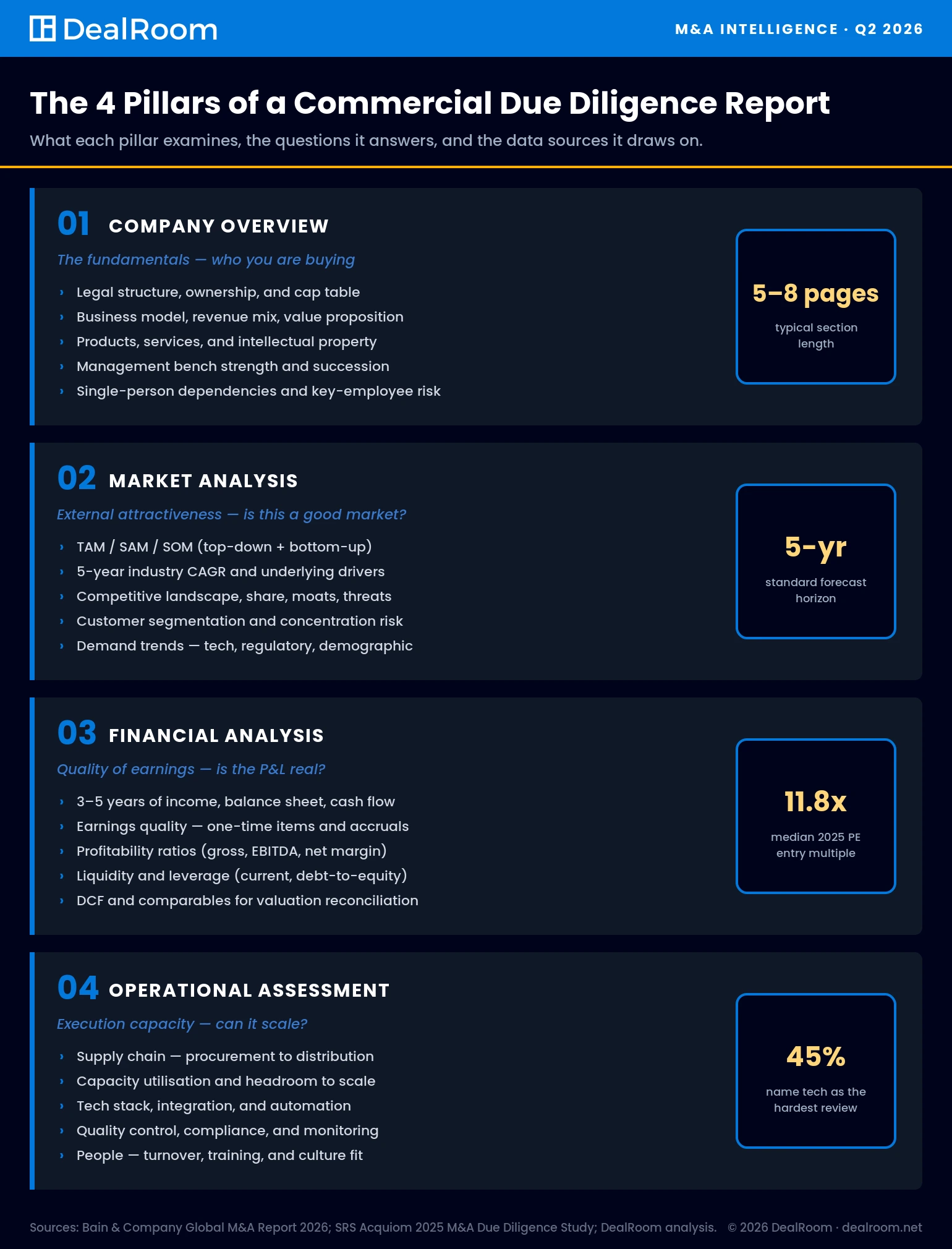
A standard commercial due diligence report includes seven sections: company overview, market analysis, competitive landscape, customer analysis, financial review, operational assessment, and risk/opportunity register. The four key analytical pillars below organize that work into a structure investment committees recognize. When read together, you will have a good feel for the true potential of the target company. Each section focuses on a unique aspect of the business, from its fundamentals to market and financial strength.
Company Overview
Start with your company overview. Describe the legal structure of the business, its ownership, and its organization so that it is clear who is really running things.
Talk about the company history, major achievements, and pivots that led to where the company is today. Include information about the business model, primary sources of revenue, and overall value proposition.
Detail the primary products or services, delivery methods, and customer acquisition. Include a list of intellectual property owned by the company (patents, trademarks, proprietary technology) that provides a competitive advantage.
Look at the management team and decide if they have what it takes to execute on the plan. Are there key employees the company cannot function without? Are there any succession plans in place?
Market Analysis
To analyze the market for commercial due diligence, size TAM / SAM / SOM, run Porter's Five Forces, and benchmark the target's share of voice against the top 5 competitors. The market analysis section focuses on the big picture: what is going on in the industry, and where the company fits. Include estimates for total addressable market, projected market growth rate, and industry maturity.
Consider any trends that are driving demand, whether they be new technologies, regulatory changes, or customer preferences. The competitive landscape analysis should identify key competitors, market share, and comparisons of strengths and weaknesses.
Determine how the company differentiates itself, and if that differentiation is sustainable. A table can be used to compare the company to its competitors on price, features, and market presence.
| Industry size | Quantified value | Projected CAGR | Assessment |
| Market share | Percentage held | Trend direction | Competitive pressure |
| Customer segments | Primary targets | Expansion potential | Concentration risk |
Segment customers by type, size, geography, and purchase behavior. Evaluate customer satisfaction by retention, repeat customers, and feedback. Look at customer concentration. If your business relies heavily on a few customers for revenue, that could be a risk factor.
Which frameworks underpin a commercial due diligence report?
Most CDD providers organize their analysis around four well-established strategic frameworks. Used in combination, they let an investment committee triangulate whether the target's market is real, defensible, and growing.
Start with top-down market sizing (TAM × penetration), validate with bottom-up triangulation (customer count × ARPU), and reconcile the two within ±15%. Use Porter's Five Forces to evaluate sustainable margin pressure: the threat of new entrants, supplier power, buyer power, threat of substitutes, and competitive rivalry. The 5C framework (Company, Customers, Competitors, Collaborators, Context) is useful for organizing the qualitative interview program. Jobs-to-be-Done is the cleanest lens for customer analysis: rather than asking why a customer chose this product, ask what job the customer hired the product to do and how unstable that hiring decision is.
A worked example: in a B2B SaaS deal, TAM is the total spend on the category globally, SAM is the spend in segments and geographies the target sells into, and SOM is the spend the target can realistically capture in the next three to five years given sales capacity. A reasonable forecast triangulates within ±15% across a top-down (TAM × penetration) and bottom-up (named accounts × ARPU) calculation; gaps wider than 15% indicate a forecast that is not yet defensible.
Financial Statement Analysis
Review three to five years of financial statements including the income statement, balance sheet, and cash flows. Identify trends in revenues and costs. Analyze how cash is being utilized.
Assess earnings quality. Identify one-time gains or losses or shifts in accounting methods. Calculate and assess financial ratios including measures of profitability (gross margin, EBITDA margin, net profit margin), liquidity (current ratio, quick ratio), and leverage (debt-to-equity, interest coverage).
Benchmark ratios against industry averages to provide context. Examine cash flow. Just because a company may be posting positive earnings on its financial statement does not mean it is receiving positive cash flow.
Identify operating cash flow, investing cash flow, and financing cash flow. Highlight any large variances between profits on the income statement and cash flow.
Forecast future performance. Review management's financial projections. Do the projections make sense given the assumptions? Stress test the projections against market conditions and company history. Value the company using discounted cash flow or compare to similar companies.
Operational Assessment
Can the company execute and scale? Walk through the entire supply chain from procurement through manufacturing through distribution. Identify any weak links or dependencies.
Evaluate production processes, current capacity utilization, and ability to scale up if necessary. Document the technology stack and level of system integration and automation.
Will existing operations scale, or will you need to invest in additional capacity? Evaluate quality control, compliance, and operational controls. What metrics are currently being monitored?
Operational risks can include bottlenecks, compliance risks, or legacy technologies. Will the company be able to maintain quality during growth?
Cyber posture is increasingly the most expensive line item in operational diligence: 45% of respondents to the SRS Acquiom 2025 M&A Due Diligence Study named technology review the most arduous aspect of due diligence. Pull SOC 2 Type II reports, the past three years of breach history (including any near-misses), the incident-response plan, and data-residency commitments to enterprise customers. Confirm that any data captured under GDPR or CCPA is handled correctly and that the seller has not made commitments that the buyer cannot keep post-close.
Technical-debt review is the other tech-side priority. Quantify monthly cloud spend and the run-rate trajectory, the scalability ceiling of the current architecture (the customer count or transaction volume at which the system requires a re-platform), and integration risk with the buyer's existing stack. A target with strong unit economics but a brittle monolith on legacy infrastructure can quietly erode the deal's IRR through Year-1 re-platforming costs the financial diligence team never modelled.
Employee expertise is also considered here. Evaluate the labor pool, employee training, and turnover. These are indicators of company culture and stability.
4 Steps to Build a Commercial Due Diligence Report

To write a commercial due diligence report, follow these four phases. Each phase follows a set of steps to ensure you have thoroughly researched the target and have an unbiased view of its commercial viability.
Phase 1: Due Diligence Preparation and Planning
Assemble your team and identify the skills necessary to complete the CDD. Skills include market research, financial modeling, and industry expertise. Also, identify what information you need to know about the target's market share and growth potential.
Create a due diligence checklist to ensure you do not overlook any steps in the process. Draft a request list for all the information you will need from the target company.
Outline the framework of your report. Open spaces should be dedicated to market sizing, competitive analysis, customer analysis, and financials. Create a template document with blank slides that will guide your data collection.
Sign a confidentiality agreement prior to requesting sensitive information. Schedule interviews with key stakeholders early. They always take longer than you plan. Ensure all parties are clear on the scope, deliverables, and success criteria.
Who performs commercial due diligence varies by deal size and complexity. In-house corporate-development teams often handle CDD on smaller add-on acquisitions where the buyer already understands the market. Dedicated CDD boutiques (L.E.K. Consulting, Bain & Company, OC&C Strategy Consultants, Simon-Kucher) are the default choice for platform deals where market dynamics are unfamiliar or the IC requires an external imprimatur. Expert networks (such as GLG, AlphaSights, Third Bridge) supply access to industry specialists for primary-research call programs. AI-assisted research providers have emerged as a fourth option for early-stage screening. The right mix depends on deal size, time available, and whether the buyer needs a third-party document the IC will trust.
Phase 2: Information Collection and Data Review
Start researching and pulling information from annual reports, industry analyses, and public filings. If there is a virtual data room available for the target company, work to gain access and begin using it as a storage system for your due diligence.
Pull together three to five years of financials, customer contracts and renewal histories, syndicated market reports, and the target's last 12 months of operating statistics. Create a due diligence log to record what you have, where you got it, and what you plan to use it for.
Review each document for accuracy. If you are missing information, send out a due diligence questionnaire to help gather additional data or clarification.
Visit the operating sites in person. Run 10 to 20 voice-of-customer reference calls covering current, churned, and prospect customers. The SRS Acquiom 2025 study found primary-research-backed CDD reports closed materially faster than desk-only reports. You may want to employ the use of a due diligence software or tool (like DealRoom Diligence) to store all of your information. Cross-check your data with multiple sources.
Phase 3: Analysis and Validation of Findings
Evaluate and corroborate your findings. Research the market size, growth, trends, and segmentation for the target. Identify the competitive landscape. Where does the target fit in, and what threats exist?
Evaluate the target's competitive advantages and sustainability. Create financial models projecting the target's future performance.
Be honest with yourself about your assumptions. Highlight your assumptions. Perform sensitivity analysis based on key assumptions.
Interview experts and compare the target to similar companies or industry benchmarks. Identify distinct risks: operational, market, competitive, and financial. Identify possible synergies or latent value that the acquirer could realize post-deal.
Continually perform sanity checks on your evaluation.
Phase 4: Report Preparation and Presentation
Begin with an executive summary. Start your report with your top recommendations and findings. Nobody should have to dig to find them.
Follow with an introduction. Include your methodology, scope, and any limitations you faced. Honesty about what you were able to do and not able to do is critical.
Separate your research into categories: market sizing, competitive landscape, customer validation, and financial overview. Each slide should be concise.
Include risk and synergies at the end of each category. Use action verbs for slide titles. Limit information to one main idea per slide. Simplify charts and graphs.
Formatting should include:
- Slide titles with clear takeaways
- Graphs and charts that are labeled clearly
- Colors and design cues
- Any assumptions or limitations should be disclosed
Conclude with specific recommendations regarding the acquisition and proposed next steps. Include appendices with supporting documentation for reviewers that wish to delve deeper into the research, data, and analysis.
Obtain anonymized sample CDD reports from similar transactions or from your CDD provider's reference library to ensure your format aligns with how investment committees in your sector consume diligence. Build your models in a manner that allows the reader to understand your thought process.
What a finished commercial due diligence report looks like
If you have never built one before, the fastest way to calibrate your draft is to read a finished example. DealRoom's sample due diligence report walks through the full structure: executive summary, scope and methodology, market and competitive analysis, customer analysis, financial review, operational assessment, and the risk and opportunity register. Use it as a benchmark for the level of detail your IC will expect, then pair it with the 52-item interactive checklist embedded above to track your own progress through each section.
Risk Assessment and Mitigation
The main risks identified in commercial due diligence fall into seven categories: demand, customer concentration, pricing, operations, technology, regulatory, and people. Risk identification is the focus of CDD. Identify risks to deal value and forecasted cash flows, quantify each risk, and develop mitigation plans to protect valuation and integration timelines.
Identifying Key Risks
Perform due diligence on yourself: what could go wrong? Risk categories should include demand, customer concentration, pricing power, operations, technology, regulatory compliance, and people. Tie each risk to a financial driver in your model (revenues, margin percentage, working capital metrics, and so on) so you can quantify impact to cash and EBITDA.
Score each risk based on likelihood to occur (1 to 5) and impact severity (1 to 5), then plot on a 5×5 heat map. Anything scoring 16 or above becomes a deal-blocker without a quantified mitigation. Frame all risks as ΔCM2 (impact to contribution margin) and ΔCash (cumulative impact to cash during the projected hold period, typically five years for a financial buyer).
Define velocity metrics where possible. Velocity helps you determine the speed of impact. How much revenue or margin is lost each week or month if your top three customers defect? What about supplier defaults or capacity bottlenecks if you are facing operational risk?
Early indicators of litigation risk (such as red-flag DD findings) should be documented upfront. IP can be invalidated through litigation, new regulations can force price increases, and data breaches can expose you to compliance risks if the target company is negligent. Develop a risk heat map scoring likelihood and financial impact by product or service line and region.
Connect each risk to early-warning indicators where possible. What leading indicators should you monitor going forward? This might include:
- Days Sales Outstanding (DSO) if there is credit risk
- Product returns if product quality is a concern
- Service Level Agreement (SLA) credits if there are technology risks
- Win rates if competitive risk is high
The 10 most common commercial due diligence red flags
- Customer concentration above 25% with the top three accounts. Why it matters: a single defection can collapse the model. Mitigation: structure an earnout against named-account retention or insist on multi-year prepaid contracts before close.
- Voluntary turnover above 15% in mission-critical roles. Why it matters: signals brittle culture or burnout that integration will worsen. Mitigation: budget retention bonuses for the named individuals before announcement.
- Decelerating net revenue retention (NRR) on the cohort curve. Why it matters: indicates the product is losing relevance to existing customers, the cleanest leading indicator of churn. Mitigation: reset the deal model to organic growth only and revisit the multiple.
- A flat or declining win rate in the last four quarters of the sales pipeline. Why it matters: shows the competitive position has weakened even if revenue lags. Mitigation: validate with a primary-research call programme before closing.
- Data-room evidence of breach incidents not previously disclosed. Why it matters: regulatory and reputational tail risk that the buyer inherits. Mitigation: cap exposure with cyber liability insurance and a specific reps and warranties indemnity.
- Termination-for-convenience clauses in the top customer or supplier contracts. Why it matters: customers or suppliers can walk for any reason post-close. Mitigation: renegotiate the clause or price the risk into the deal.
- Founder dependence with no succession plan. Why it matters: the IP, the customer relationships, and the strategy all live in one person's head. Mitigation: condition close on a multi-year founder-employment agreement and a documented org chart.
- Audit trail gaps in the past three years of financial statements. Why it matters: any unaccounted-for adjustment is a place where surprises hide. Mitigation: hold escrow until the auditor signs off on the trailing year.
- A regulatory enforcement action open in the company's primary jurisdiction. Why it matters: fines, distractions, and possible operating restrictions post-close. Mitigation: confirm the resolution path and the cost-cap in writing before closing.
- Scalability ceiling on the current technology stack at fewer than 2× today's transaction volume. Why it matters: re-platforming consumes Year-1 IRR. Mitigation: model the re-platform spend explicitly and decide whether the deal still pencils.
Mitigation Planning
Plan mitigations that reduce frequency or exposure or cap severity. Structure seller reps and escrows with clear thresholds for financial risks driving price down (for example, payment processor putting more reserve into deal, DSO continues to deteriorate). Consider earnouts to share downside risk if renewals do not materialize.
Look to operationalize risk by budgeting for dual sourcing, inventory reshuffling, or capacity cushions in year one. If technology is creating single points of failure, mandate reviews of APIs and committed reserved cloud capacity before close.
Conduct parallel legal due diligence to identify contracts with change-of-control provisions, non-compete loopholes, IP entanglements, and any termination-for-convenience clauses that customers or suppliers could trigger post-close. Negotiate cure periods and the need for consent into closing. Assign owners and budget risks into deal proceeds for any compliance gaps you discover (missing certifications, sustainability/ESG findings).
Consider transferring risk through cyber liability insurance, D&O insurance, and business interruption insurance. Quantify the ROI of each mitigation by dividing cost by the expected value of impact reduction (dollar amount of impact reduced multiplied by probability of risk occurring). Prioritize mitigations that pass your ROI threshold.
Compliance and Legal Considerations
Ensure your legal due diligence report enumerates laws by jurisdiction such as licensing and tariff requirements, certifications, employment laws, and environmental requirements. Understand whether any upcoming EPR fees, packaging regulations, or auditing mandates may impact future margins and price these into your model.
Look at litigation by size and date. Quantify attorneys' fees and litigation reserves. Understand if open litigation will affect major customers or revenue. Identify trends in employment or regulatory actions that could be indicative of bigger issues.
Look for termination clauses, price escalators, exclusivity, and SLA breaches that may change the economics after close. Double-check that the target is in compliance with all data-privacy laws (GDPR, CCPA). If they are not, this can affect timing of post-close integration and could result in monetary penalties.
Evaluate the risk and compliance team and infrastructure relative to your competitors. Inadequate controls lead to higher operational risk and could affect post-close integration.
Perform stress tests on the compliance program. Do the procedures and controls scale? Will legal and auditing costs grow exponentially as you scale the business? Try to use any gaps in compliance as negotiating points for price or indemnity caps.
Commercial Due Diligence Report FAQs
Most commercial due diligence reports follow a consistent seven-section structure that mirrors the questions an investment committee will ask before approving a deal. Learn the essentials and field-tested tricks to make sure your report facilitates deal decisions, not document length.
What sections are included in a commercial due diligence report?
A standard commercial due diligence report covers seven sections: company overview, market analysis, competitive landscape, customer analysis, financial review, operational assessment, and risk/opportunity register. Together they help you assess whether the business is logical, has a competitive advantage, and can create scalable growth.
What is the standard structure of a commercial due diligence report for mergers and acquisitions?
You can format a commercial due diligence report in many different ways, but most reports follow a common structure. Here is a quick overview:
- Executive Summary: provide an overview of your key findings and recommendations
- Introduction: scope, methodology, data sources
- Market: competition, customers, operations, financials. Try to link your commercial findings to the forecast and value here
- Risk and Opportunity Assessment: recommendations and appendices, attach any supporting data and charts here
Where do I get information for a commercial due diligence report?
Maintain a source log. Record where you found every bit of information you use (date, page number, how it was used in the report). That way you will not get frustrated later when someone asks you, “Where did you get that number?”
Use quality sources first. Annual reports, reputable market research, regulatory filings, and company websites are good places to start. Go for the low-hanging fruit later if you must.
Make an assumption if data is missing. Look for comparable markets or situations to base your assumptions on. Write down your assumptions so others can follow your thought process.
Attempt to schedule interviews with management, customers, and industry experts early. They can take a while to schedule but usually provide information that you will not find in written form. Cross-check information with more than one source if possible.
What are the best practices for writing a clear and concise due diligence report?
Use action verbs to title your slides. One main thought per slide, with supporting data. Put your conclusion up top, then explain. Use complete sentences, but do not be wordy. Start with an outline. Align stakeholders early on project scope and priorities.
How should financial information be presented in a commercial due diligence report?
Present current financials in simple tables and charts with trend lines. Break out revenue and compare historicals to forecasts. Do sensitivity analyses on major value drivers. Be realistic in your assumptions, double-check for errors, and keep models simple.
How do you recommend approaching market analysis for due diligence?
Start top-down with TAM × penetration, validate bottom-up with customer count × ARPU, and reconcile the two within ±15%. Use Porter's Five Forces to evaluate sustainable margin pressure. Look at competition benchmarks. Talk to experts.
Key Takeaways
- Commercial due diligence reports explore a target's market position and competitive advantage to determine its investment prospects.
- Market, competitor, customer and financial modeling, and risk comprise the main sections.
- Advance preparation, targeted investigation, explicit assumptions, and transparency help create a strong report.
Commercial diligence should answer how a business has performed. It should also answer whether the business will continue to perform (and grow) in a competitive marketplace. When done right, commercial diligence will give you the confidence to close, renegotiate, or eliminate risk before any capital is put on the line.
Achieving that level of confidence is often complicated. You are collecting information from various sources, lining up stakeholders, and confirming assumptions. Not to mention communicating all of that into a format that is digestible and ready for decision making. That is where DealRoom comes in.
The DealRoom M&A Platform is purpose-built for buyer-led M&A. It consolidates the diligence checklist, request log, and post-close synergy tracking that a CDD report eventually feeds into. Say goodbye to spreadsheets, disorganized documents, and dozens of email chains. Store information and keep data organized, assign and track diligence requests, and log findings in one central platform. Workflow automation, live collaboration, and powerful reporting tools keep your team organized and aligned throughout your entire process.
In M&A, most poorly performing deals fail due to poor execution, not poor strategy. DealRoom closes the gap between due diligence and execution. Instead of allowing commercial due diligence insights to go to waste after deal closing, they can be used to fuel integration planning, synergy tracking, and continued value generation.
Want to make quicker, smarter, and more confident investments? Process is key. The DealRoom M&A Platform allows your commercial due diligence process to be scalable. Schedule a demo today to see how DealRoom can improve your commercial due diligence.